

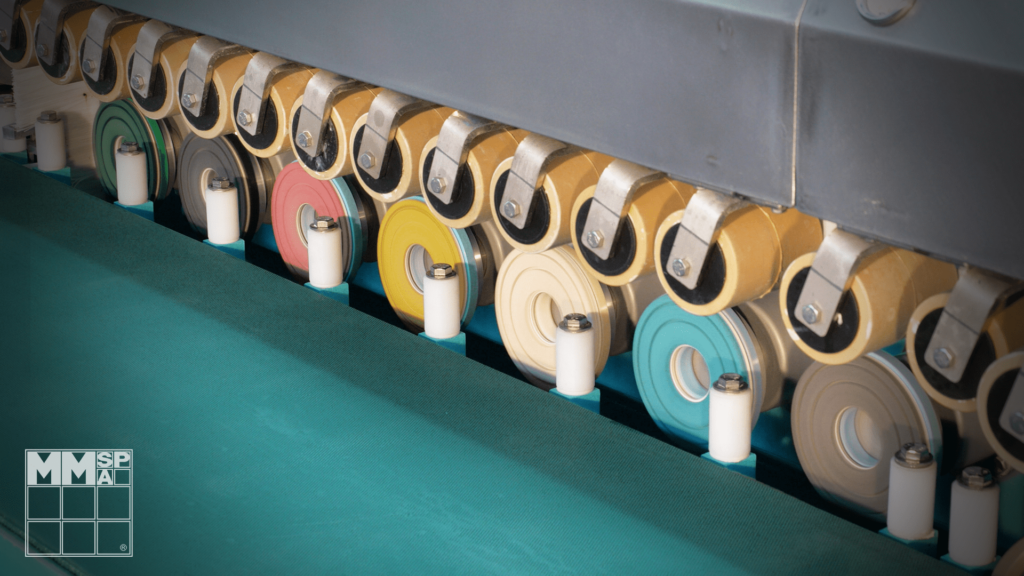
Perhaps one of the least considered factors when choosing a new edge polisher, the transport system is instead a decisive design choice in terms of machine efficiency.
There are two “macro-families” of transport systems on the market: the free belt with fixed pressure rollers (“NLRF”) and the guided belt with pneumatic drive pressure rollers (“NGRP”). Although the latter is very common in the current edge polisher market, the NLRF system offers greater advantages, both in terms of performance and maintenance. Those who work in the stone production sector know well that technical solutions must be reliable, durable, and efficient, which means “achieving the best results in the simplest way possible”. On the other hand, “sophistication” rhymes with “headache I don’t want to have.” That’s why the free belt and fixed roller system is better, and that’s why Marmo Meccanica applies it to all its machines.

But what are the pros and cons?
Here are briefly the Advantages of the “Free Belt – Fixed Rollers” system:
- Does not require position sensors: the free belt is always in contact with the piece and the rollers push the piece against the reference edge, eliminating uncertainty about the piece’s position as it passes through. (Not to be confused with the thickness sensor, which is still an available option but not necessary)
- The fixed rollers are mounted on a solid structure and do not have their own individual piston. This means that overall maintenance is significantly reduced, and eliminates a complexity from the lists of “what can go wrong” and “what will require expensive maintenance.”
- The pressure of the rollers on the panel or slab is significantly lower. With an NGRP type belt, the high pressure required to hold the piece is often the cause of slab breakage, especially on thinner (15 mm or less) and more fragile materials (veined marble, ceramics, porcelain). The NLRF rollers rely on the stable position of the bar, not on active pressure, and the rollers are mounted on springs, which are also better in terms of vibration absorption.
- Since NLRF machines are designed and built according to the aforementioned philosophy, this system leads to less bulky and sophisticated machines, thus a better quality/price ratio compared to NGRP machines of the same category.
- It is possible to work with the shiny side either up or down, although the latter solution is increasingly convenient in both systems, as it allows for thickness calibration and avoids leaving roller marks on the polished surface.


As with all technical solutions, of course, the free bench and fixed rollers solution also has some disadvantages, but they are much more limited and emerge only under certain specific conditions, namely:
- Does not allow for “skipping” material ribs (like the underside of a kitchen countertop with laminates) without any additional support. However, applying extra support, such as extendable spacers, is still simple and economically more convenient.
- It is not possible to work with slabs of different thicknesses simultaneously. But how often does a producer need to run the machine with such different thicknesses in succession? In terms of workflow and managing large productions, it is natural to organize the slabs by thickness. So this is not a major disadvantage.


